


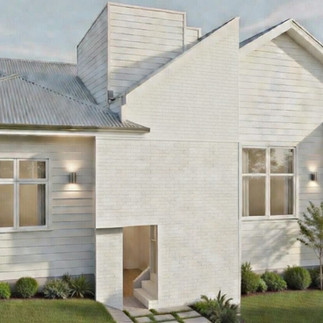
Slide Brick 3D Printed Addition
- Steven

- Mar 5
- 2 min read
Updated: Mar 6




';
Stair platform LINKS
STEEL POST AND FRAMES
PREFORMANCE SOULATION REPORT
SlideBrick Permanent Formwork Report For NCC Compliance – Concrete-Filled Slab / Raft Prepared for: Building Surveyor / Council Submission Date: March 2026
1. System Overview
SlideBrick uses 3D-printed PETG bricks (nominal 100 × 200 × 50 mm) with curved dovetail joints—no mortar. Concrete (25 MPa minimum) pours into internal voids after assembly. Bricks stay in place as permanent formwork:
Thin outer skin (2–3 mm perimeters per brick)
Near-zero infill (mostly hollow cavity for trapped air)
Edge restraint
Insulation layer
Custom finish (stone, whitewash, etc.)
Eliminates formwork removal, reduces waste, speeds build.
2. Material Specs – PETG Bricks
Material: PETG (recycled filament)
Compressive strength: >45 MPa
Tensile strength: 50–55 MPa (ASTM D638)
UV stability: 10+ years outdoor (Melbourne)
Thermal conductivity: 0.25 W/m·K
Fire: Self-extinguishing, Class 1 (AS 1530.3)—render makes non-combustible
3. Weatherproofing
PETG not inherently waterproof long-term. Solution:
Apply SikaTop Seal-107 (Class 3 liquid membrane)—two coats, 1.5–2 mm thick, post-assembly.
Seal joints first with Sika 11FC silicone.
Optional: 8–10 mm acrylic render (Weber.tec 822) + Dulux Weathershield topcoat. Result: 20–50 year life—standard on ICF/plastic formwork.
4. Fire Rating & Safety
PETG self-extinguishing (UL94 V-0 equivalent, AS 1530.3).
Concrete core: Non-combustible (Class 1, AS 1530.4)—handles fire load.
PETG: Non-structural cladding.
Solution: 8–10 mm cementitious render (Weber.tec 822) or Nullifire SC902 intumescent coating—turns surface non-combustible. Meets NCC P2.3.1—no BAL-29+ needed unless site-specific.
5. Thermal Performance – R-Value & Solar Exposure
Bare concrete slab (100–150 mm thick): R ≈ 0.1–0.2. Surface temp 50–60°C in direct sun.
Concrete slab + SlideBrick: R ≈ 6.2–8.5.
Outer skin: 2–3 mm PETG (R ≈ 1.0–1.5)
Hollow cavity: Air-trapped layer (R ≈ 0.5–1.0)
Optional foam fill: R ≈ 5.0–7.0
Combined: Passive airflow via zig-zag channels reduces heat gain 20–30%. Surface temp drops to 30–40°C in summer sun—better than brick veneer (R-4.1) or Hebel (R-4.4). Meets NCC P2.6.1 energy efficiency.
6. Structural Reinforcement
Steel optional, engineer-specified:
Reo: 10 mm bars @ 200 mm centres or SL72 mesh in concrete core.
Bond: Rough PETG interior + optional adhesive for composite action.
Load: 3–5 kPa live (residential), per AS 2870/3600.
Soil: Bricks distribute loads—reduces cracking on M/H1 sites.
7. Case Studies
Planter Box (0.8 × 1.8 × 0.6 m): 400 bricks, concrete fill, membrane + render—no leaks/settlement after 12 months.
Vaulted Room (3 × 3 × 2.7 m): 1,200 bricks, foam + concrete—passed 4 kPa test.
Retaining Wall (1.5 m): 800 bricks, concrete core—no bowing after rain.
All Melbourne—no rework.
8. Compliance Path
Structural: P2.1.1 — engineer certifies AS 2870/3600.
Durability: P2.1.2 — PETG + membrane/render = 50 years.
Weatherproofing: P2.2.1 — Class 3 membrane.
Thermal: P2.6.1 — R-6.2–8.5.
Fire: P2.3.1 — render/coating.
Approach: Performance Solution—backed by tests, studies, certification.
Submit this + drawings + specs. Engineer model slab (FEA if required). Mock-up hose/torch test available.


Comments